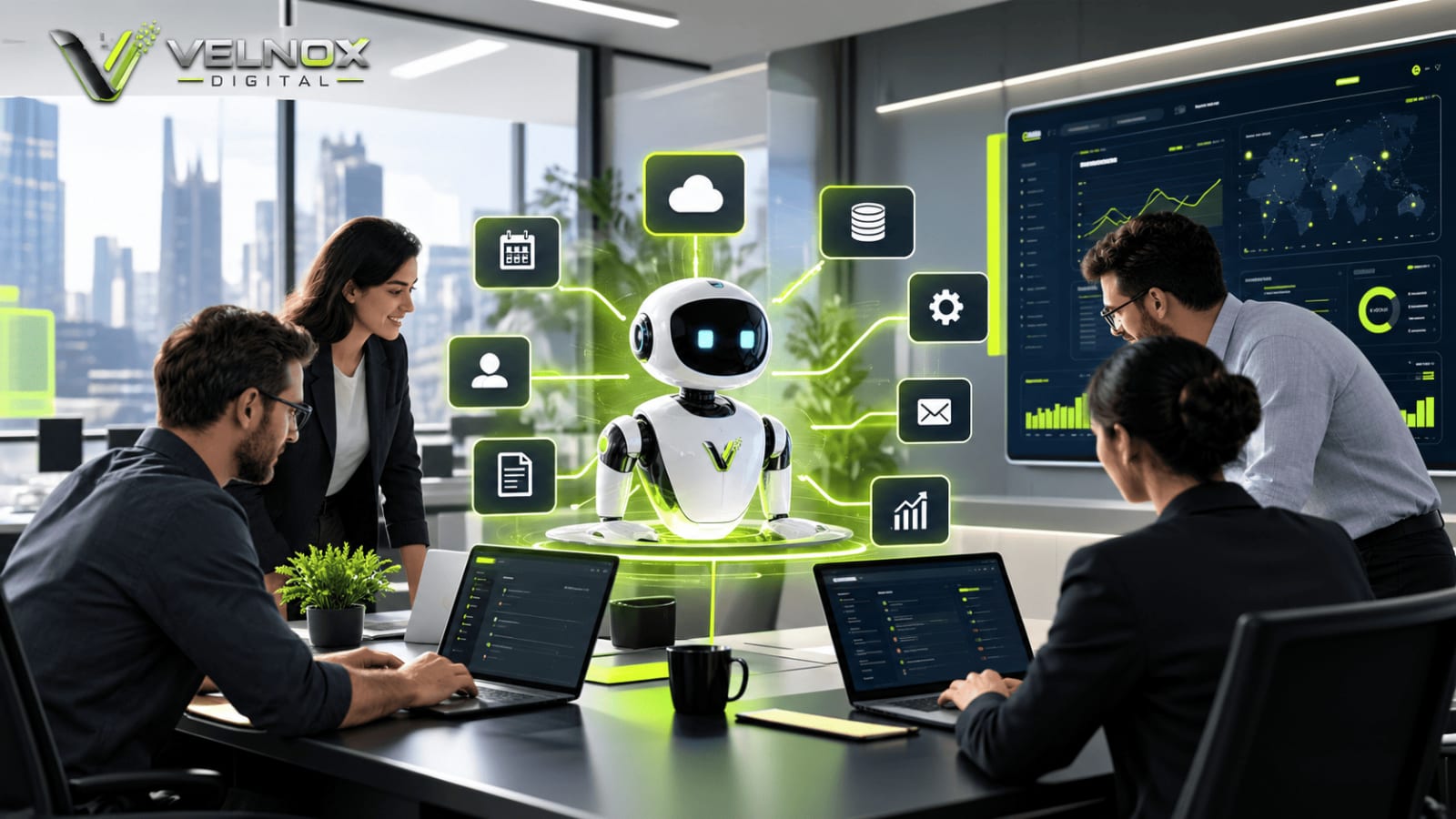
Enterprise AI agent development helps large companies build AI systems that can understand goals, use business data, connect with software, and complete multi-step tasks. Unlike a basic chatbot, an enterprise AI agent can work inside real business workflows while keeping human approval, security, and business rules in place.
For companies looking at enterprise ai agent development services, the goal should not be to add AI everywhere. The better approach is to find repetitive work that is safe to automate, connect the right systems, and measure the business result.
What Is Enterprise AI Agent Development?
Enterprise AI agent development is the process of designing, building, integrating, testing, and deploying AI agents for business use.
An enterprise agent can combine:
Large language models (LLMs)
Company knowledge and documents
APIs and business software
Databases
CRM systems
Workflow automation
Search and retrieval systems
Monitoring and analytics
Human approval steps
The agent can then take a goal and perform several actions instead of giving only a text response.
Featured Snippet: What Is an Enterprise AI Agent?
An enterprise AI agent is an AI-powered software system that can understand a business task, access approved information, use connected tools, complete defined actions, and send sensitive or complex work to a human.
How Are Enterprise AI Agents Different From Chatbots?
A chatbot mainly answers questions. An AI agent is built to complete work.
Feature | Basic Chatbot | Enterprise AI Agent |
|---|---|---|
Main purpose | Answer questions | Complete business tasks |
Input | User messages | Goals, events, data, requests |
Tools | Usually limited | APIs, CRM, databases, software |
Workflow | Mostly conversational | Multi-step |
Decision-making | Limited | Within defined rules |
Human handoff | Optional | Often built into the workflow |
Monitoring | Basic | Performance and business metrics |
Best use | FAQs and support | Operations, sales, research, automation |
For example, a chatbot might answer, “What services do we offer?”
An enterprise agent could research a lead, collect approved company information, score the lead, update the CRM, prepare a follow-up, and send it to a salesperson for approval.
That difference is why enterprise AI needs more planning than simply adding an AI chat window to a website.
Why Do Enterprises Need AI Agents?
Large companies often have many repetitive processes spread across different systems.
Employees may spend hours:
Copying information between platforms
Researching prospects
Updating CRM records
Preparing reports
Sorting support requests
Summarizing documents
Checking data
Routing tasks
Preparing meeting notes
Following up with leads
Not every task should be automated. Velnox Digital's published 60% rule recommends starting with repetitive, judgment-free work while keeping tasks involving risk, relationships, strategy, or important decisions with people.
This approach is useful because more automation is not always better automation.
The goal is to automate the right layer of a workflow.
What Can Enterprise AI Agents Automate?
The best use cases are usually tasks that happen often, follow a clear process, and have measurable results.
Business Area | Example AI Agent Tasks | Human Role |
|---|---|---|
Sales | Lead research, qualification, routing | Approve important opportunities |
Customer Support | Answer routine questions, classify tickets | Handle complex cases |
Marketing | Research, reporting, segmentation | Strategic decisions |
Operations | Data collection, routing, workflow updates | Handle exceptions |
Research | Gather and summarize approved information | Review findings |
Finance | Document extraction and workflow support | Final financial decisions |
HR | Internal information and process support | Sensitive employee decisions |
Management | Reporting and business summaries | Strategic judgment |
Velnox's AI Automation offering covers AI agents, voice agents, chatbots, workflow automation, GEO/AEO, and AI analytics, making it possible to combine agents with wider business automation instead of treating them as standalone tools.
For a deeper look at how agents differ from other AI systems, the existing guide on AI agent development companies and services is a useful related resource.
What Does Enterprise AI Agent Development Include?
A production AI agent needs more than a good prompt.
1. Workflow Discovery
First, the team should understand:
What the business process is
Where employees spend time
Which systems are involved
What data the agent needs
Where errors could cause harm
Which steps need human approval
Velnox Digital starts its AI Automation process by mapping repetitive workflows and scoring them by automation ROI.
2. Agent Architecture
Next, developers choose the right architecture.
This could be:
One AI agent
Multiple specialized agents
An AI chatbot
A voice agent
Traditional automation
A hybrid workflow
A simple task should not receive an unnecessarily complex multi-agent system.
3. System Integration
The agent may need controlled access to:
CRM software
Databases
APIs
Internal documents
Search systems
Calendars
Analytics platforms
Business applications
The important point is controlled access. An enterprise agent should only receive the permissions and tools required for its job.
4. Testing and Evaluation
Before launch, the system should be tested against normal cases and failure cases.
A practical evaluation checklist includes:
Correct answers
Wrong or missing information
Edge cases
Tool failures
Security boundaries
Human escalation
Hallucinations
Unexpected user requests
Repeated tasks
Velnox includes evaluation and QA, approval gates, fallbacks, and monitoring as part of its AI Automation delivery.
Enterprise AI Agent Architecture: What Does It Look Like?
A simple enterprise agent architecture can be understood in five layers:
User or business event → AI reasoning → approved knowledge → connected tools → action or human approval
For example:
A new lead enters the CRM.
The agent reads the lead information.
It retrieves approved company and market data.
It researches and scores the opportunity.
It updates the CRM.
It prepares the next action.
A salesperson approves the important step.
This structure keeps the AI useful without giving it unlimited control.
Traditional Automation vs. Enterprise AI Agents
Area | Traditional Automation | AI Agent |
|---|---|---|
Rules | Fixed | Can interpret context |
Input | Structured | Structured + natural language |
Workflow | Predefined | Can select steps within limits |
Flexibility | Lower | Higher |
Testing | Usually simpler | Requires broader evaluation |
Best for | Repetitive deterministic tasks | Selected complex workflows |
Risk | Easier to control | Needs stronger guardrails |
Important: An AI agent is not automatically better than traditional automation.
If a task follows a simple rule every time, normal automation may be faster, cheaper, and easier to test.
How Should Enterprises Decide What to Automate?
Use this simple three-level model:
Workflow Type | Example | Recommended Approach |
|---|---|---|
Deterministic | Data entry, tagging, routing | Automate |
Probabilistic + easy review | Summaries, first drafts, scoring | AI + human check |
High-impact | Strategy, negotiation, sensitive decisions | Keep human-led |
A Simple 5-Question Automation Test
Before building an agent, ask:
Does this task happen often?
Is the process reasonably clear?
Can the result be checked?
Can a wrong result be reversed?
Is the business value measurable?
If most answers are yes, the workflow may be a strong automation candidate.
This matches the practical approach described in Velnox Digital's article on what AI should actually automate, where the focus is on automating repetitive work while protecting higher-risk human judgment.
What About Enterprise AI Security and Governance?
Security should be considered before deployment, not after an agent is already connected to company systems.
NIST's AI Risk Management Framework is designed to help organizations manage AI risks and incorporate trustworthiness into the design, development, use, and evaluation of AI systems. NIST also provides a Generative AI Profile for risks that are specific to generative AI.
Enterprises should consider:
Identity and access controls
Data permissions
Sensitive information
Audit logs
Human approval
Output validation
Model and vendor risk
Monitoring
Incident response
Secure integrations
For AI application security, organizations can also review the OWASP Top 10 for LLM Applications as part of their security planning.
For broader AI governance, ISO/IEC 42001:2023 specifies requirements for establishing, implementing, maintaining, and continually improving an Artificial Intelligence Management System.
These frameworks do not replace an organization's own security or compliance requirements. They provide useful structures for managing AI risk.
What Should You Look for in Enterprise AI Agent Development Services?
When comparing enterprise ai agent development services, do not choose a provider only because it lists many AI models.
Look for a team that can handle the full system.
Enterprise AI Agent Development Checklist
✓ Understands your business workflow
✓ Can integrate existing software
✓ Uses controlled data access
✓ Provides testing and evaluation
✓ Includes human approval where needed
✓ Supports monitoring after launch
✓ Measures business outcomes
✓ Documents the system
✓ Allows future model changes
✓ Clearly explains ownership
Velnox Digital describes itself as an AI-first studio of operators, engineers, and designers. Its stated intelligence stack includes Claude, OpenAI, LangChain, Python, Supabase, AWS, HubSpot, Segment, GA4, and BigQuery.
Its AI Automation service states that the first production agent typically takes 4–8 weeks, with a senior team of 3–4 people and weekly reporting.
What Is the Best Development Process for Enterprise AI Agents?
A simple process can keep the project focused.
1. Audit
Map the workflow and find repetitive tasks.
2. Prioritize
Choose the workflow with the strongest combination of:
Business value + frequency + low risk + measurable outcome
3. Prototype
Build a small working version before expanding the system.
4. Integrate
Connect the agent to the required business tools and approved information.
5. Test
Evaluate accuracy, edge cases, security, failures, and human handoffs.
6. Launch
Deploy with monitoring and clear ownership.
7. Optimize
Review real-world performance and improve the workflow based on measured results.
Velnox's broader working model follows a similar path from discovery and strategy through development, launch, and optimization.
How Much Do Enterprise AI Agent Development Services Cost?
There is no single price for enterprise AI agent development.
The cost depends on:
Workflow complexity
Number of integrations
Data requirements
Number of agents
Security requirements
Testing requirements
Infrastructure
Monitoring
Ongoing optimization
Project Type | Typical Complexity |
|---|---|
Simple internal assistant | Low |
Lead qualification agent | Medium |
Customer support agent | Medium |
CRM-connected sales agent | Medium–High |
Multi-system operations agent | High |
Multi-agent enterprise platform | Very High |
A useful way to compare providers is to look at the total delivery scope, not only the initial development price.
A cheap prototype can become expensive if it lacks testing, monitoring, security, integrations, or ownership.
Enterprise AI Agent Development for Sales and Customer Operations
Sales is one of the clearest areas for agent-based workflows.
An agent can help with:
Collecting lead information
Enriching approved data
Scoring leads
Routing opportunities
Updating CRM records
Preparing follow-ups
Creating internal summaries
For customer operations, an agent can answer routine questions, retrieve approved information, classify requests, and send complex cases to a human.
For phone-based workflows, Velnox's published guide on AI voice agents that book meetings explains why narrow scope, real calendar integration, structured handoffs, and human escalation are important.
Real Business Value Matters More Than AI Features
A good enterprise agent should have clear metrics.
Track things such as:
Metric | What It Shows |
|---|---|
Tasks completed | Agent workload |
Human escalation rate | How often people are needed |
Accuracy | Output quality |
Response time | Speed |
Hours saved | Productivity |
Qualified leads | Sales value |
Conversion rate | Business performance |
Cost per workflow | Efficiency |
Revenue impact | Financial value |
This is important because AI activity is not the same as business value.
Velnox's approach focuses on measurable outcomes rather than simply counting automated tasks. Its AI Automation service says workflows are instrumented against pipeline and margin.
Why Choose Velnox Digital for Enterprise AI Agent Development?
Velnox Digital positions itself as an AI-first studio focused on combining strategy, technology, and growth.
Its AI Automation offering includes:
AI agents
Voice agents
Chatbots and assistants
Workflow automation
GEO and AEO
AI analytics
Evaluation and QA
Monitoring dashboards
Team playbooks
The company also states that clients keep their prompts, pipelines, and infrastructure rather than being locked into an agency-owned system.
For businesses that need supporting digital infrastructure, Velnox also works across custom software, web development, SEO, marketing, and data analytics.
Its published work includes an eShaafi AI automation case study, where AI automation was combined with performance marketing and branding to improve operational efficiency and build a more connected digital growth system.
Build the Right AI Agent for Your Enterprise
The strongest AI agent development for enterprise companies starts with a real business problem.
Instead of asking, “Where can we use AI?”, ask:
“Which repetitive workflow is costing our team the most time and can be safely improved?”
That question leads to better architecture, clearer KPIs, and a more useful AI system.
Velnox Digital can audit repetitive workflows, build production AI agents, connect them with existing business systems, and create measurement and QA layers around the automation. Explore its AI Automation capabilities if your company is ready to turn a specific workflow into a measurable AI-powered system.
You can also review Velnox Digital's completed work to see how the team approaches measurable digital systems across different industries.
Frequently Asked Questions
What is enterprise AI agent development?
Enterprise AI agent development is the process of building AI systems that can understand business tasks, access approved information, use connected tools, and complete defined workflows with appropriate human controls.
How are enterprise AI agents different from chatbots?
Chatbots mainly answer questions. Enterprise AI agents can use tools, access business systems, complete multiple steps, and trigger actions within defined limits.
Can AI agents connect to enterprise software?
Yes. AI agents can connect with approved APIs, CRMs, databases, knowledge bases, calendars, analytics platforms, and other business systems.
Are enterprise AI agents secure?
They can be designed with access controls, authentication, monitoring, approval steps, output validation, and other security controls. The correct design depends on the business use case and risk level.
Should enterprises automate every workflow?
No. Simple and repetitive tasks are often better candidates. Sensitive, strategic, relational, or high-impact decisions may still require people.
How long does enterprise AI agent development take?
The timeline depends on the workflow, integrations, data, security requirements, and testing needs. Velnox Digital currently states that its first production agent typically takes around 4–8 weeks.